Renewable power
Saudi dedicated renewable systems
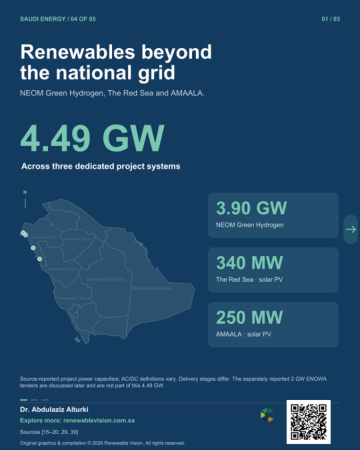
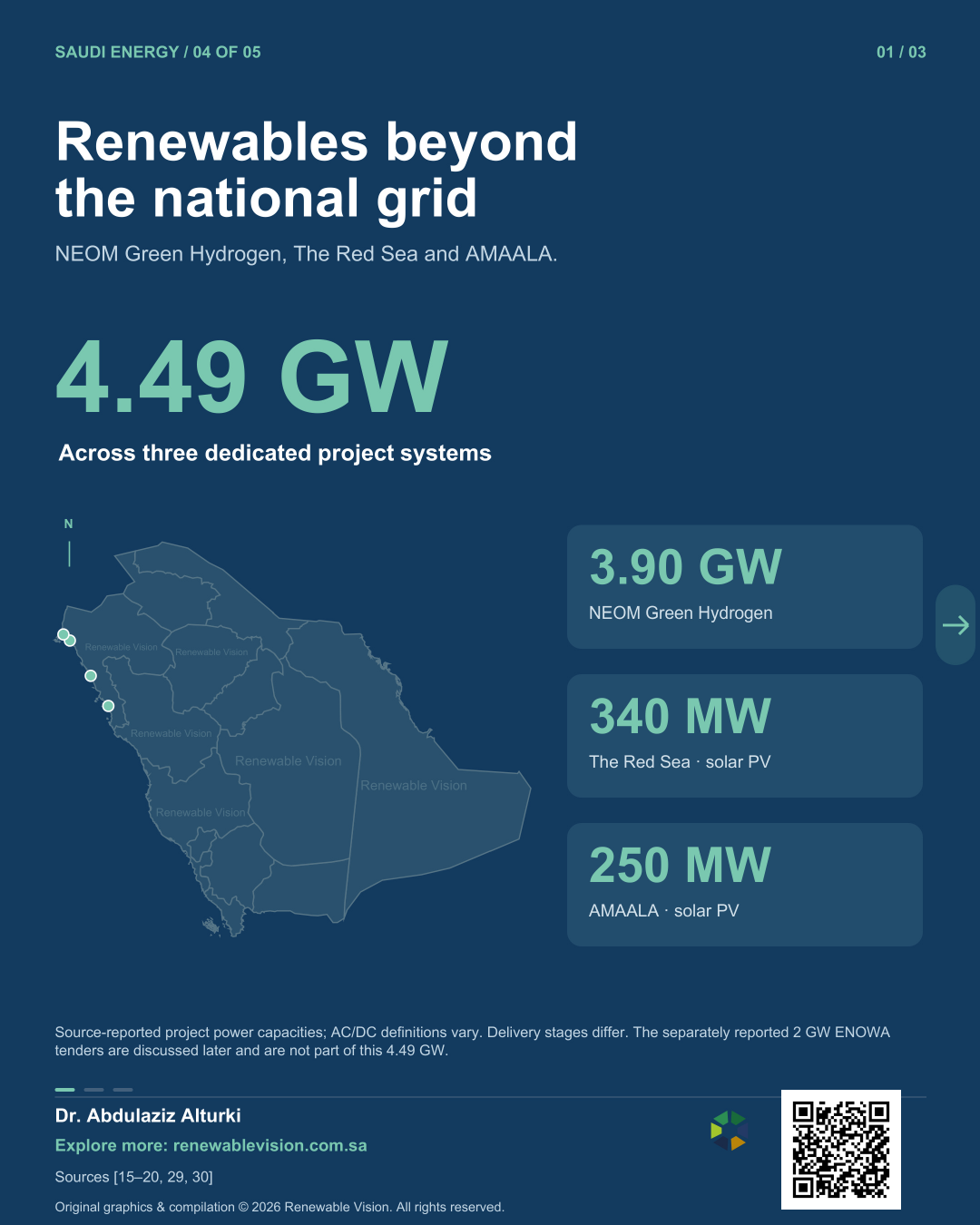
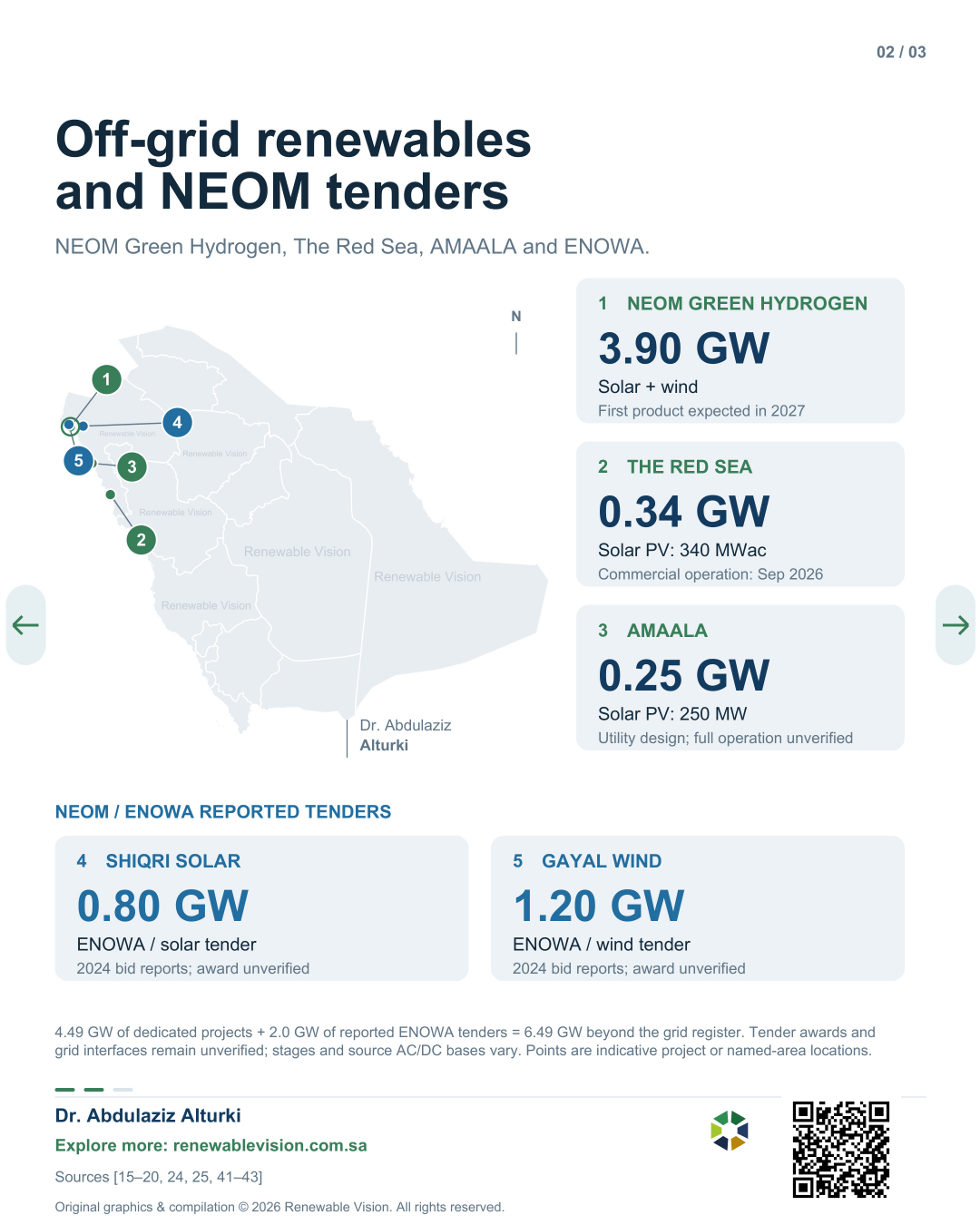
Covers the three dedicated renewable systems that supply industry and destination developments directly: NEOM Green Hydrogen, The Red Sea and AMAALA, at 3.90 GW, 340 MW and 250 MW of source-reported project capacity, 4.49 GW together, with each system's power definition and delivery stage set out separately. Two ENOWA tender reports totalling 2 GW are mapped beside them and are not added to that subtotal, because they date to July 2024 and their current awards are unverified. Figures are as compiled on 12 September 2026.
- Compiled 12 September 2026
- 3 pages
What the report covers
Dedicated renewable systems show how Saudi energy investment connects directly to industry and destination development.
NEOM Green Hydrogen, The Red Sea and AMAALA together account for 4.49 GW of source-reported renewable project capacity: 3.90 GW, 340 MW and 250 MW respectively. Their power definitions and delivery stages differ.
NEOM connects renewable generation and storage to hydrogen production. The Red Sea combines solar power and batteries within an off-grid utility system; commercial operation was announced on 6 September 2026. AMAALA's utility design combines solar and storage, while full utility commercial operation remains unverified in the source set.
The common planning question is how electricity, storage and the services they support should be designed together.
The project map also identifies two separate ENOWA tender reports totaling 2 GW. Those are July 2024 procurement reports, with current awards unverified, and are not added to the three-project 4.49 GW subtotal.
Which industrial uses are best suited to dedicated renewable utility systems?
What the figures mean
Quoted from the report's own notes on scope and definitions, in the words it published them in.
- 70 GW renewable project coverage: rounded from 63.813 GW in the grid-project register + 4.49 GW across NGHC, The Red Sea and AMAALA + 2 GW of separately reported ENOWA tenders. This combines different project stages and source AC/DC conventions; it is not operating capacity or a new official national total. The two ENOWA reports date to July 2024; current awards and final grid interfaces are unverified.
- 44.3 GWh battery projects: 18 GWh energized grid capacity + 4 GWh of further Saudi Energy awarded projects + 8 GWh under SPPC Group 1 agreements + 12 GWh of Group 2 procurement + 2.327 GWh in dedicated systems = 44.327 GWh. It is not an all-operating fleet total. Power in GW and energy in GWh are separate quantities.
- Dedicated battery ratings: Red Sea 1.227 GWh + AMAALA 0.700 GWh + NGHC 0.400 GWh. EDF's 0.770 GWh AMAALA figure and Sungrow's 0.600 GWh DC NGHC quantity have different reporting bases and are not additional projects.
- LCOE map coverage: all 41 registered solar projects (51.613 GW) and 12 wind projects (12.200 GW) are represented. Hollow markers show 10 solar and five wind projects without published prices. This is the full grid-project register; dedicated off-grid projects are covered in the separate dedicated-systems PDF.
- Renewable price averages: sum of project capacity multiplied by its reported price, divided by total priced capacity. Solar: 31 priced projects, 36.513 GW, approximately 1.47 US cents/kWh. Wind: seven priced projects, 6.700 GW, approximately 1.77 US cents/kWh. Unpriced projects are excluded from the averages but remain on the maps. These are capacity-weighted means, not medians or generation-weighted averages; reported contract vintages are retained.
- Battery costs: the approximately USD 120/kWh and USD 123/kWh Tabuk and Hail figures are capital-cost comparisons using the cited procurement energy basis. The 6.5 US cents/kWh storage benchmark is an Ember modeled LCOS excluding charging energy, not a Saudi auction discharge tariff.
- Locations: points are project or named-area proxies where surveyed plant coordinates are unavailable. The ENOWA tender locations are indicative named areas. They do not establish final engineering footprints.
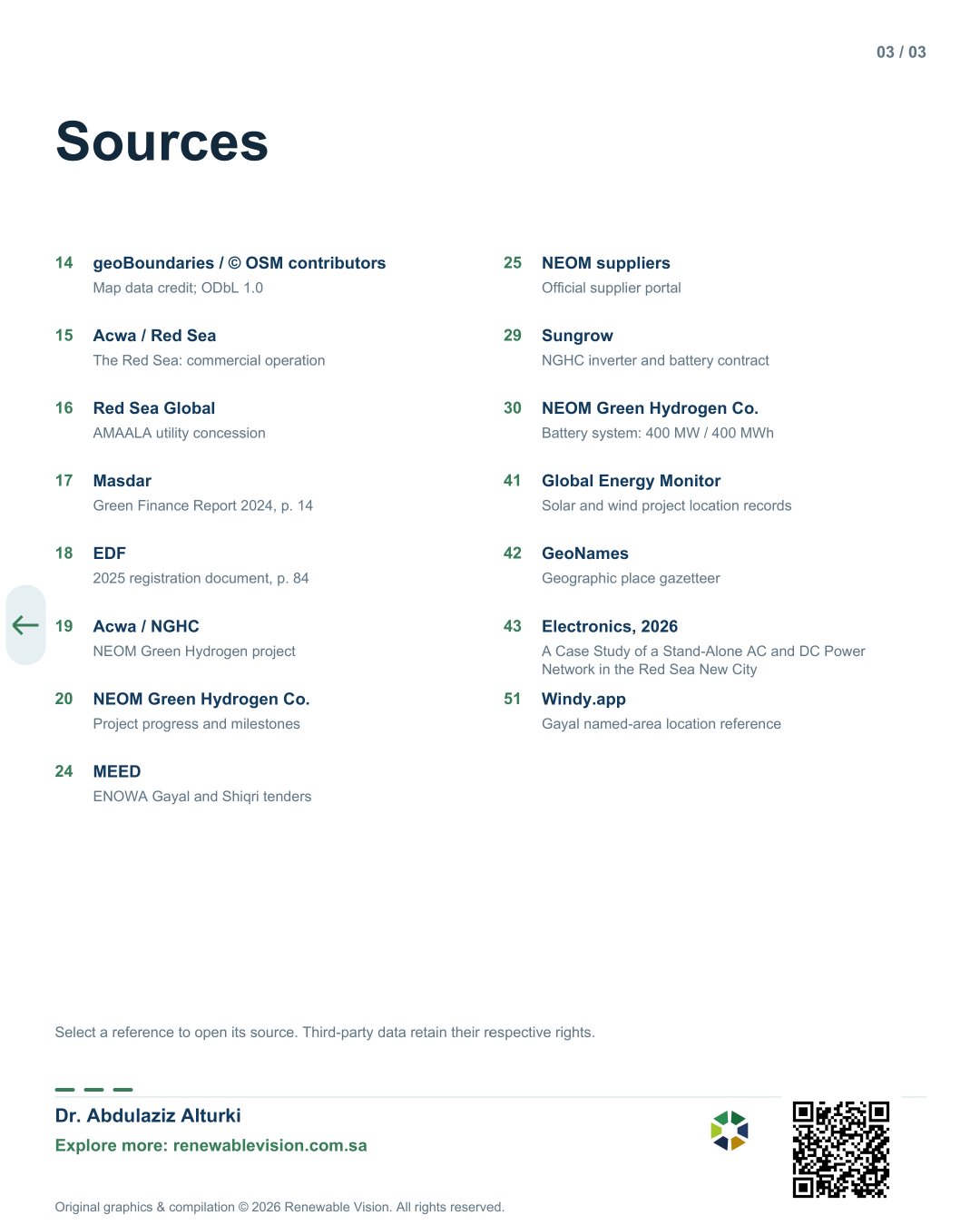
Sources
The PDF carries its own source page as well.
- Acwa
- Red Sea Global
- Masdar
- Acwa
- NEOM Green Hydrogen Co
- MEED
- KAPSARC — Renewable Energy Projects Dashboard
- SPPC / Principal Buyer — Renewable project register
- SPPC / Principal Buyer — Round 7: six projects, 5,300 MW
- SPPC / Principal Buyer — Round 7 qualified developers
- SPPC / Principal Buyer — Round 6 awards and exact LCOEs
- SPPC / Principal Buyer — Seven PPAs totaling 15,000 MW
- Saudi Energy — H1 2026 earnings release, p. 4
- Saudi Energy — H1 2025 results presentation, p. 8
- NR Electric — 2.5 GW storage cluster energized
- HiTHIUM — Tabuk and Hail: 4 GWh contract
- SPPC / Principal Buyer — Group 1: four storage agreements
- Saudi Press Agency / SPPC — Group 2: all six project locations
- SPPC / Principal Buyer — Group 2 qualified applicants
- geoBoundaries / © OSM contributors — Saudi province map data
- EDF — 2025 registration document, p. 84
- Tecnicas Reunidas — Yanbu hydrogen FEED award
- Larsen & Toubro — Yanbu renewables and grid scope
- GlassPoint — Maaden Solar I project
- NEOM — Official supplier portal
- Etimad — Al Khafji solar technical support
- Royal Commission for AlUla — Official supplier portal
- Italian Trade Agency / MEED — Round 7 deadline reporting
- Sungrow — NGHC inverter and battery contract
- NEOM Green Hydrogen Co. — Battery system: 400 MW / 400 MWh
- IRENA — Renewable capacity statistics 2026
- IEA — COP28 capacity pledge: 2025 update
- KAPSARC — Dashboard project coordinates and unrounded prices
- Maaden — Solar steam showcase at Ras Al Khair alumina refinery
- Aramco — Renewables not that new
- Aramco — First wind turbine at Turaif Bulk Plant
- Bundesnetzagentur — Onshore wind auction statistics
- Bundesnetzagentur — Ground-mounted solar auction statistics
- UK Department for Energy Security and Net Zero — Allocation Round 7 completed results
- China NDRC / NEA — Renewable electricity pricing reform, Notice 136
- Global Energy Monitor — Solar and wind project location records
- GeoNames — Geographic place gazetteer
- Electronics / MDPI — A Case Study of a Stand-Alone AC and DC Power Network in the Red Sea New City
- DistancesFrom — Al Midra Tower coordinates
- The Wind Power — Turaif oil storage depot wind turbine
- Saudi Energy / Saudi Exchange — Al-Muwaih storage services agreement
- Saudi Energy / Saudi Exchange — Haden storage services agreement
- Saudi Energy / Saudi Exchange — Kahafah storage services agreement
- Ember — How cheap is battery storage?
- SaudiGulf Projects — SEC receives bids for 1,000 MW battery storage
- Windy.app — Gayal named-area location reference
Preview
3 of 3 pages shown
Get the report
Saudi dedicated renewable systems
Get the PDF free with membership
The PDF and the data files are free for members. Membership takes a minute: verify an email address or a mobile number once, and the download opens along with the dashboards and CSV export.
Create a free account and the download starts as soon as you are in. You come back to this report.
Not ready to join?
Weekly update
Saudi renewables, weekly: stage changes, tenders and commercial operation dates. One email on Sunday.
By continuing with one of these accounts, you accept the terms of use, including the licence and the member terms, and the privacy policy.
We use your details to provide access and, if you opt in, to send you the weekly brief or the alerts you choose. Privacy policy
Figures are as filed on 12 September 2026; live dashboards may differ. Open the live dashboard