Carbon management
Global CCUS project landscape
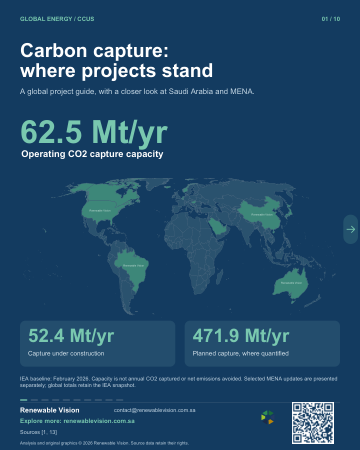
Maps the global carbon capture, utilisation and storage pipeline, then looks closely at Saudi Arabia, the UAE, Qatar and the wider MENA region, separating capture from transport and storage and operating assets from proposals. The IEA's February 2026 baseline records 62.5 Mt CO₂ a year of operating capture capacity, 52.4 Mt a year under construction and 471.9 Mt a year planned where capacity is quantified; capture and storage totals overlap on the same CO₂ and are not additive. Jubail is shown with both of the phase 1 capacities its official sources report rather than one. Figures are as compiled on 19 September 2026.
- Compiled 19 September 2026
- 10 pages
What the report covers
Global carbon capture capacity is growing, but project stage matters.
The IEA's February 2026 project baseline records:
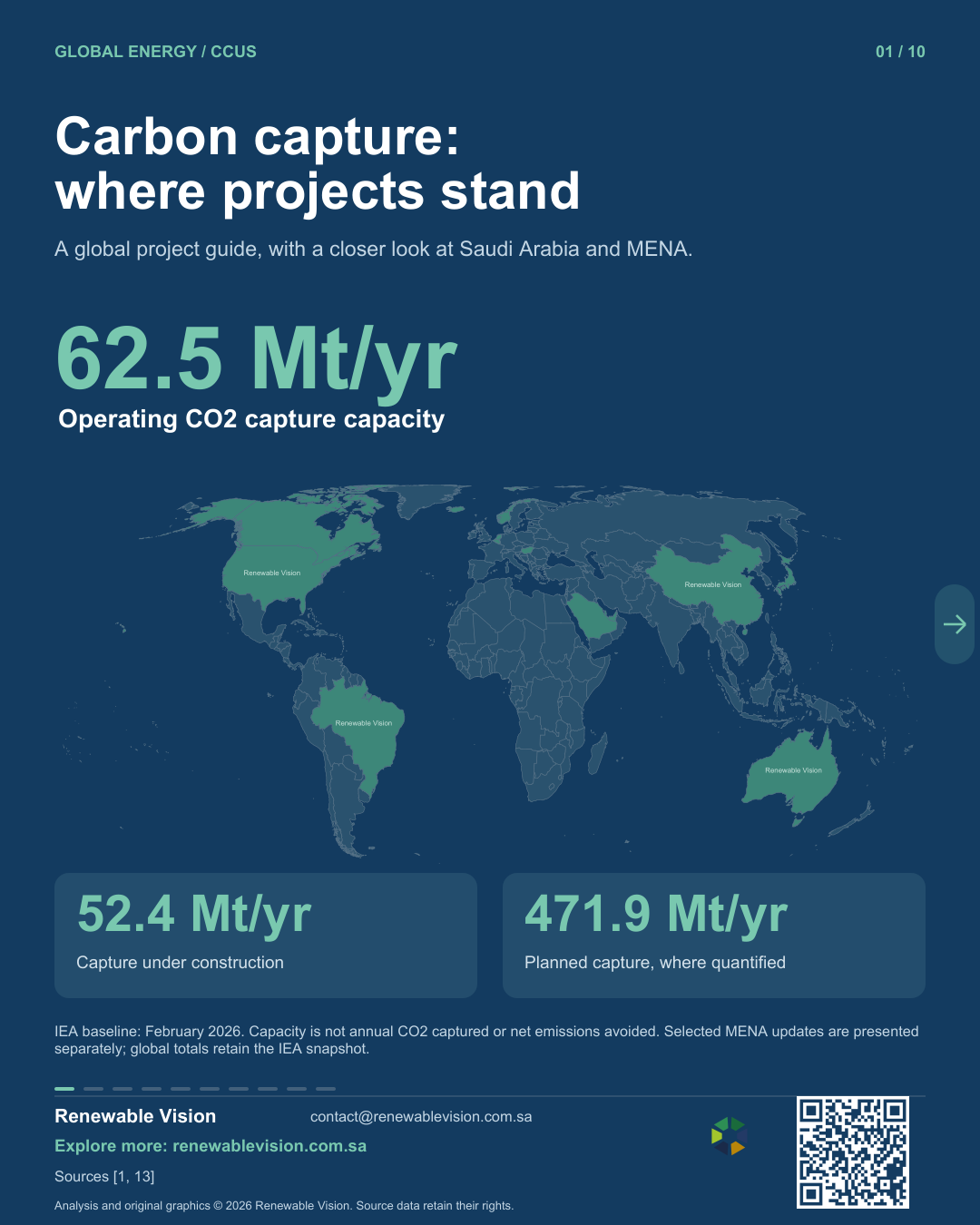
- 62.5 million tonnes of CO2 per year of operating capture capacity.
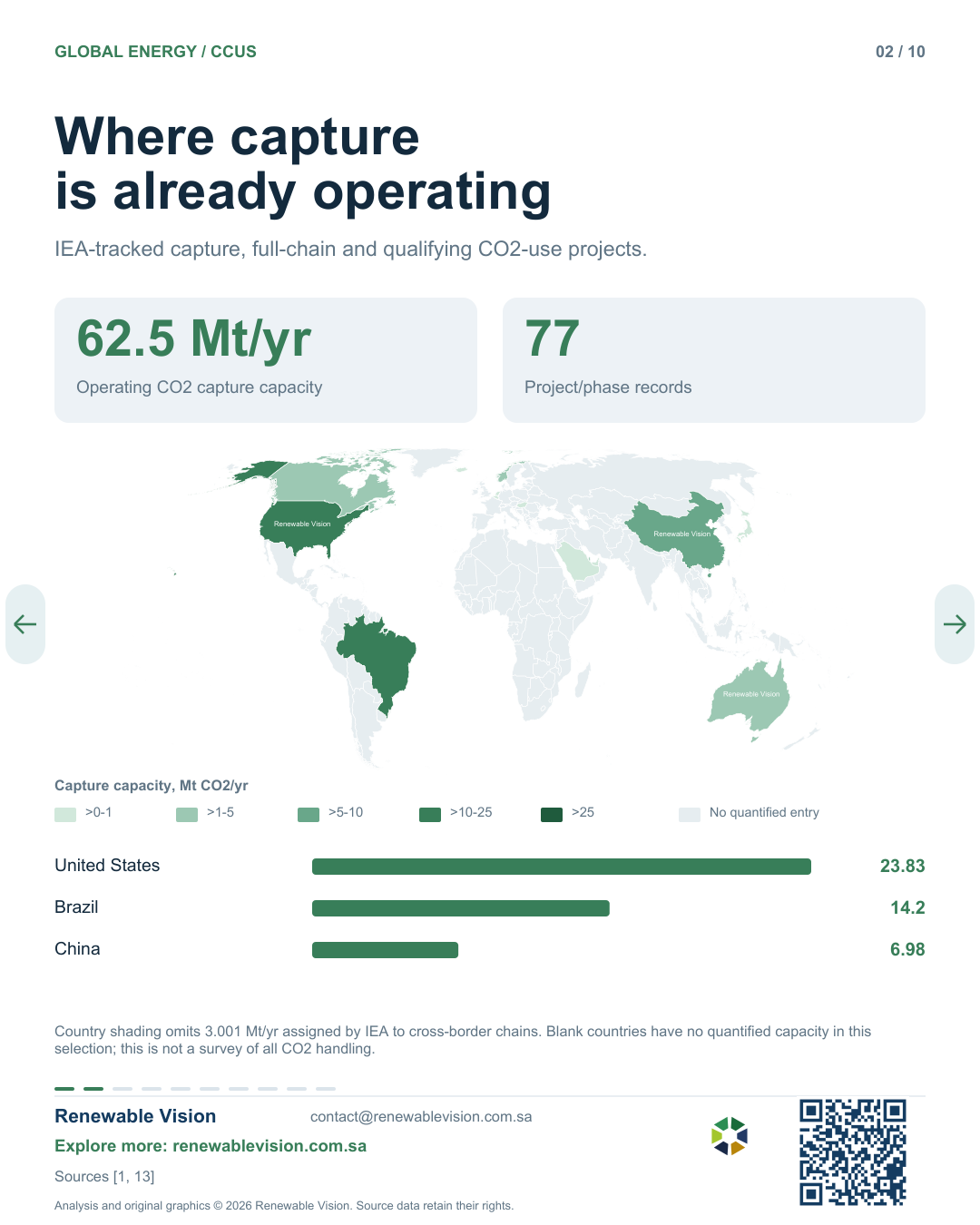
- 52.4 million tonnes per year under construction.
- 471.9 million tonnes per year planned, where capacity is quantified.
This Renewable Vision guide maps the global picture and examines Saudi Arabia, the UAE, Qatar and the wider MENA region. It separates capture from transport and storage, major industrial projects from pilots, and operating assets from proposals.
Jubail shows why those distinctions matter: its capture sources feed a shared storage hub, so adding both capacities would double-count the same CO2. Official sources also differ on its phase 1 capacity; the guide shows that difference openly.
What the figures mean
Quoted from the report's own notes on scope and definitions, in the words it published them in.
- Operating capture: 62.534 Mt CO2/year in 77 project/phase records. These are not asserted to be 77 separate facilities. Filtering the source phase field alone leaves 76 entries, but at least one extension entry has an empty phase field, so no physical-facility count is published.
- Capture under construction: 52.414 Mt/year in 51 records, including one record without a capacity.
- Planned capture: 471.935 Mt/year in 555 records, with 129 unquantified records.
- MENA capture in the supplied register: 3.801 Mt/year operating and 14.8 Mt/year under construction. The MENA subset includes Libya (source typo “Lybia”) and the joint Oman-UAE entries, totaling 27 records.
- Compound cross-border entries are not assigned to a single country on the world maps. The global operating total includes 3.001 Mt/year from such entries; country shading omits them.
Preview
3 of 10 pages shown
Get the report
Global CCUS project landscape
The PDF and the data files are free for members. Membership takes a minute: verify an email address or a mobile number once, and the download opens along with the dashboards and CSV export.
Figures are as filed on 19 September 2026; live dashboards may differ.