AI and data centres
Saudi Arabia’s AI expansion
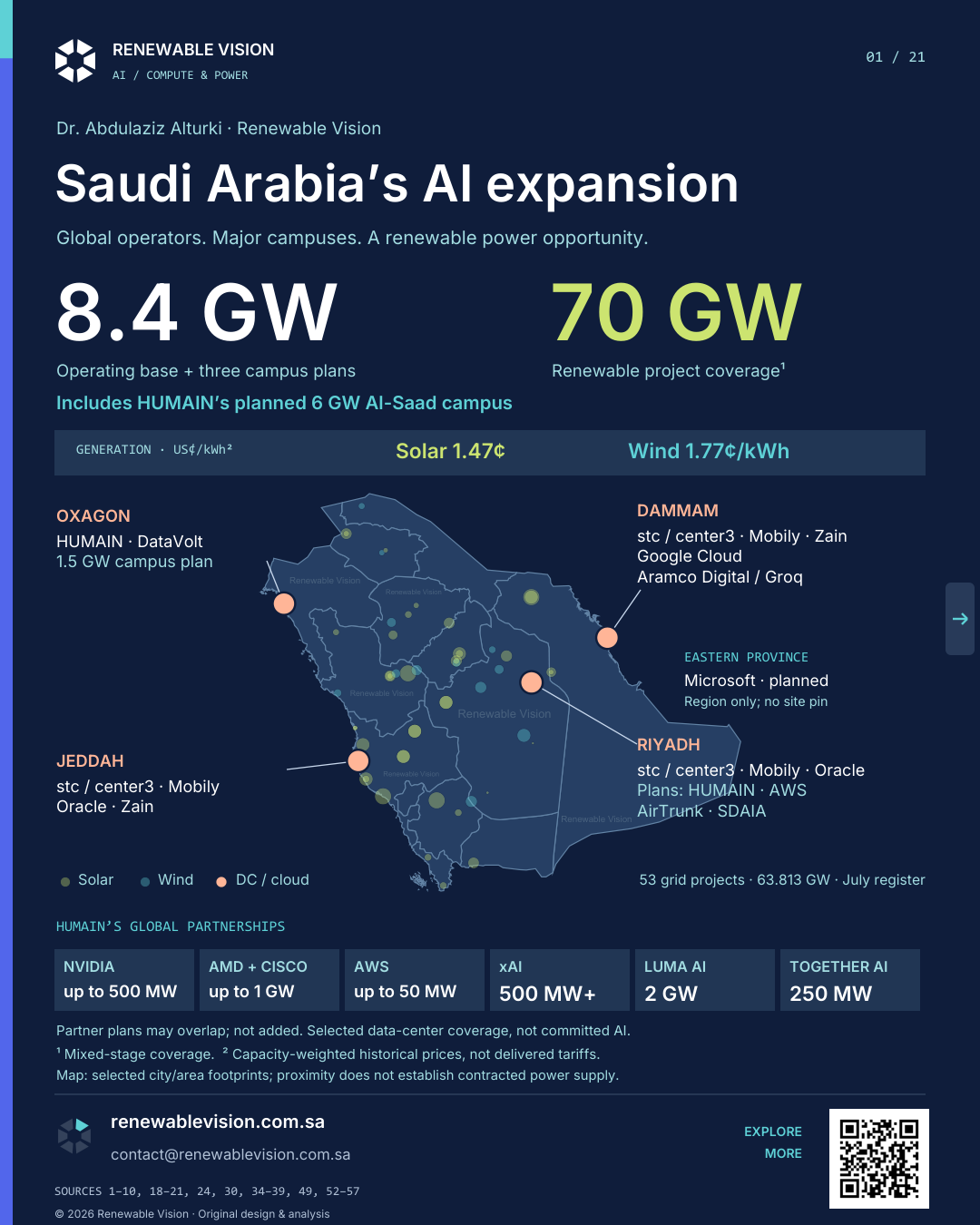
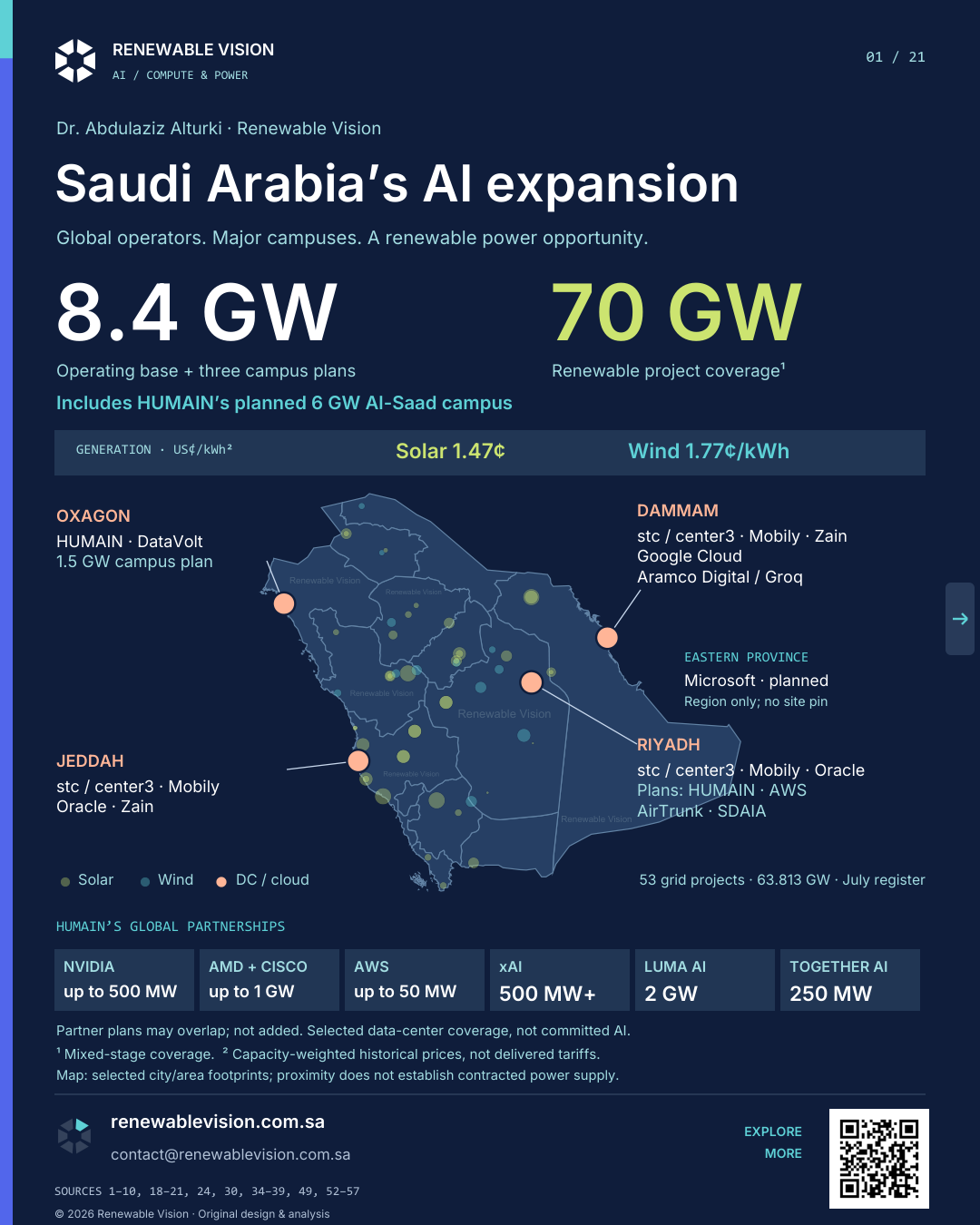
Maps the Saudi data-centre and AI compute build-out: the operating base, the campus plans, and the technology and cloud partnerships around them, with campus ratings kept apart from phases and contracts so one announcement is not counted twice. The cover figure is 8.4 GW of reported capacity, rounded from 8.447 GW — the 467 MW national operating baseline plus the Al-Saad, Oxagon and Hexagon campus plans — which the report states is selected mixed-stage coverage, not operating or committed AI capacity. Figures are as compiled on 21 September 2026, and each record keeps its own source date.
- Compiled 21 September 2026
- 21 pages
What the report covers
8.4 GW of reported capacity across Saudi Arabia’s operating data-center base and three major campus plans.
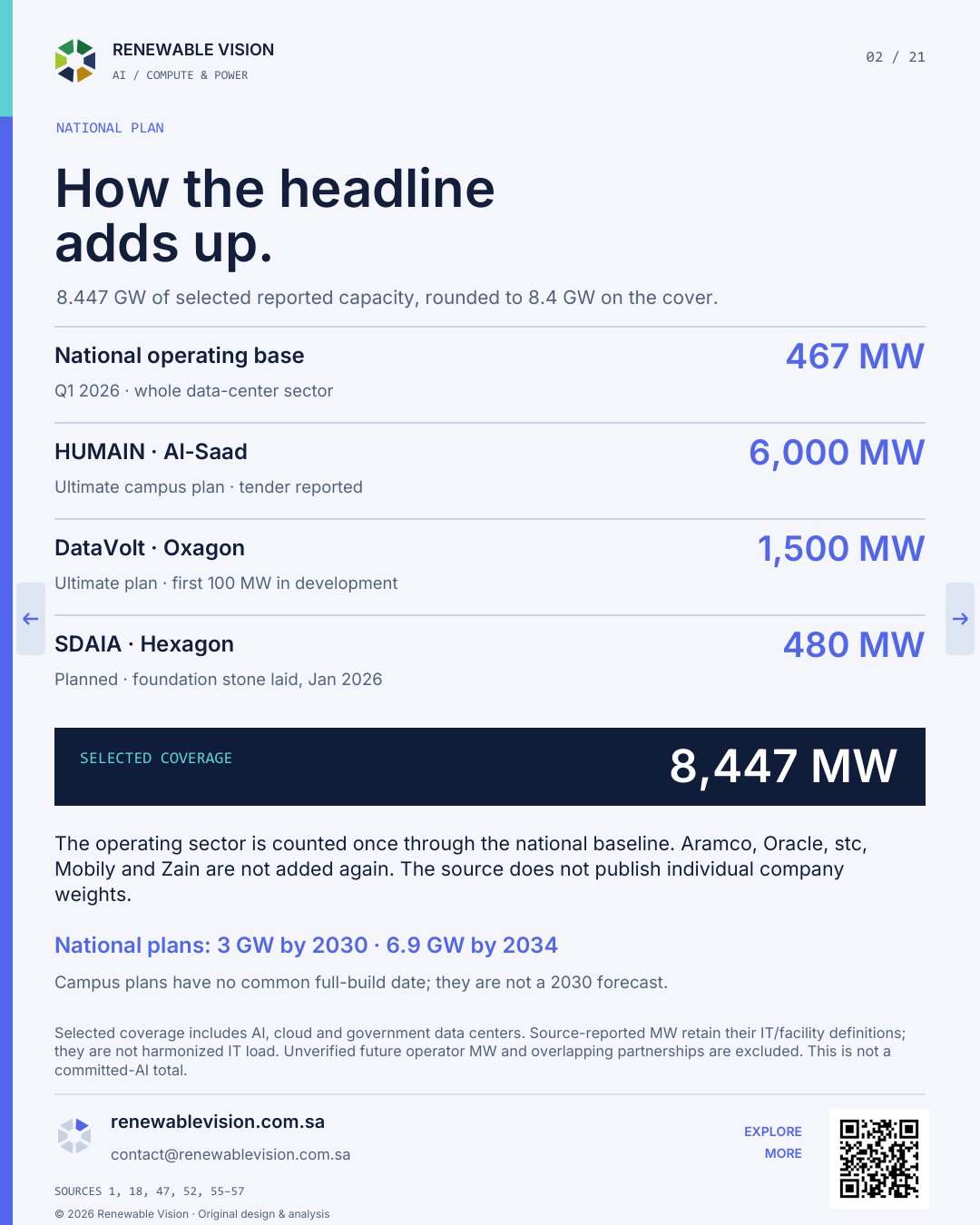
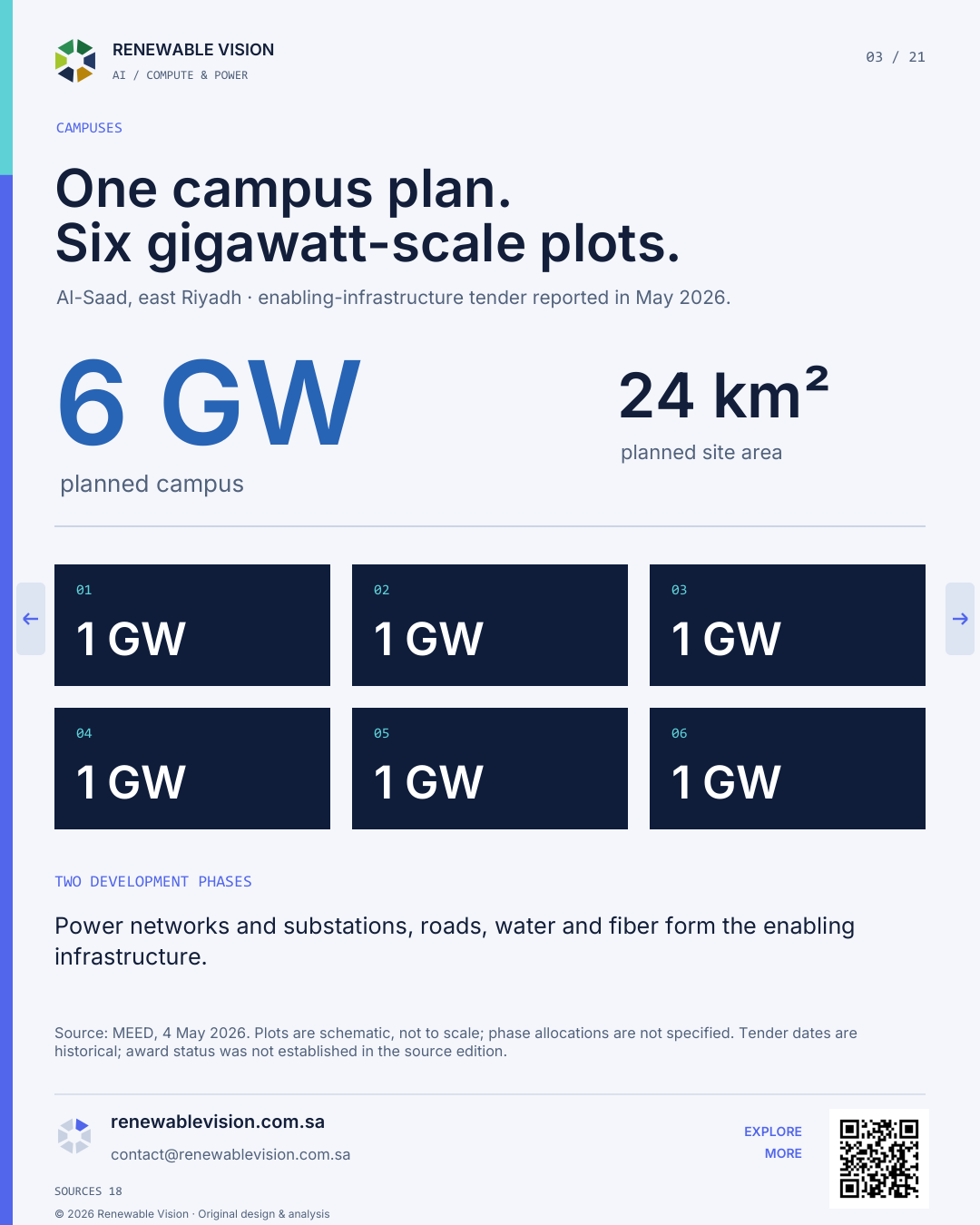
The calculation: 467 MW in the national operating baseline, HUMAIN’s planned 6 GW Al-Saad campus, DataVolt’s 1.5 GW Oxagon campus and SDAIA’s 480 MW Hexagon project. This is selected mixed-stage coverage, not 8.4 GW operating or committed AI capacity.
NVIDIA. AMD and Cisco. AWS. xAI. Luma AI. Together AI. These partnerships show the breadth of the compute ecosystem taking shape. Their announced capacities can overlap with campus plans, so they are not added again.
Saudi Arabia’s AI opportunity extends from the power system to the cloud.
The national data-center plan reaches 3 GW by 2030 and 6.9 GW by 2034. Alongside it are major campus ambitions: HUMAIN’s planned 6 GW Al-Saad campus and DataVolt’s 1.5 GW Oxagon campus.
But the market is wider than those two projects. Aramco Digital, Oracle, stc/center3, Mobily and Zain are part of the infrastructure and service base, alongside HUMAIN’s technology and cloud partnerships.
This Renewable Vision report maps who is involved, what is operating, what is planned and where the energy opportunity lies. It also distinguishes campus ratings from phases and contracts, so overlapping announcements are not counted twice.
The power context matters: the earlier Renewable Vision register covers about 70 GW of renewable projects across stages. Its priced sample has capacity-weighted historical benchmarks of 1.47 US cents/kWh for solar and 1.77 for wind. These are generation benchmarks, not round-the-clock delivered tariffs.
Competitive AI exports will depend on turning that starting position into dependable power, efficient cooling, advanced compute and customers.
What the figures mean
Quoted from the report's own notes on scope and definitions, in the words it published them in.
- 8.4 GW is Renewable Vision's selected mixed-stage coverage, rounded from 8.447 GW: the 467 MW whole-sector operating baseline plus Al-Saad 6,000 MW, Oxagon 1,500 MW and SDAIA Hexagon 480 MW. This broad indicator retains published rating conventions; it is not harmonized IT capacity, an exhaustive pipeline, committed AI or a common-year forecast.
- Existing companies are represented through the national operating baseline, whose publisher does not disclose company-by-company weights. Their entire future plans cannot be assumed included. Undisclosed or unresolved future operator MW are not added as estimates.
- 467 MW: official operational data-center capacity in Q1 2026, reiterated by MCIT in July. Includes more than AI; IT/facility boundary is not fully specified in the release.
- 3 GW by 2030 and 6.9 GW by 2034: MCIT national plans for the whole data-center sector. They are not a sum of corporate announcements.
- Al-Saad 6 GW and Oxagon 1.5 GW: distinct ultimate campus plans without a common complete-build deadline. Hexagon 480 MW: a separate SDAIA government-campus project with foundation stone laid in January 2026. These three plans are counted once; phases and partnerships are excluded from additional capacity.
- stc/center3: 250 MW reported total and 202 MW live at end-2025; the latter is contained in the former.
- Mobily: 39 MW development program, containing 13 MW commissioned in 2025. These are not the entire technical/commercial portfolio; the broader >122 MW disclosure has a different boundary.
- Aramco Digital/Groq: inference partnership and live Dammam service. Oracle: Riyadh and Jeddah public cloud regions. Zain: selected Jeddah/Dammam site disclosures and a September DataVolt MoU. Comparable MW are not disclosed in the reviewed primary sources and remain null rather than zero.
- HUMAIN/MIS: 250 MW signed planned scope, disclosed 20 September 2026; execution via later work orders. The earlier 50 MW is replaced, not added.
Sources
The PDF carries its own source page as well.
- NEOM / DataVolt. Oxagon AI campus construction. 31 Aug 2026
- AMD / Cisco / HUMAIN. Systems live; 250 MW next phase; 1 GW target. 31 Aug 2026
- AWS. Cloud region December 2026; AI Zone up to 50 MW by 2028. LEAP 2026
- AWS / HUMAIN. AI Zone location: Riyadh. 19 Nov 2025
- Microsoft. Saudi Arabia East: November 2026 availability. Aug 2026
- Oracle. Riyadh and Jeddah cloud regions. Current service page
- Google Cloud. Dammam cloud region open. 15 Nov 2023
Preview
3 of 21 pages shown
Get the report
Saudi Arabia’s AI expansion
The PDF and the data files are free for members. Membership takes a minute: verify an email address or a mobile number once, and the download opens along with the dashboards and CSV export.
Figures are as filed on 21 September 2026; live dashboards may differ.