Critical minerals
Global critical minerals
Maps the six mineral groups behind grids, batteries and clean-energy equipment — copper, lithium, nickel, cobalt, graphite and magnet rare earths — and keeps mining, refining, reserves and resources as separate quantities rather than one figure for supply. It sets the IEA baseline beside IRENA, USGS, Ember, DNV and OECD readings and keeps the differences visible, including the Jabal Sayid announcement of about 114 million tonnes of ore, which the report records as a minister-announced estimated resource rather than certified reserves. Figures are as compiled on 19 September 2026.
- Compiled 19 September 2026
- 14 pages
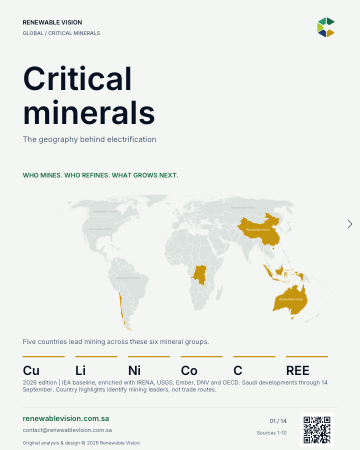
What the report covers
Electrification is changing the map of industrial supply.
Where minerals are mined, where they are refined, and where reserves are held can tell very different stories.
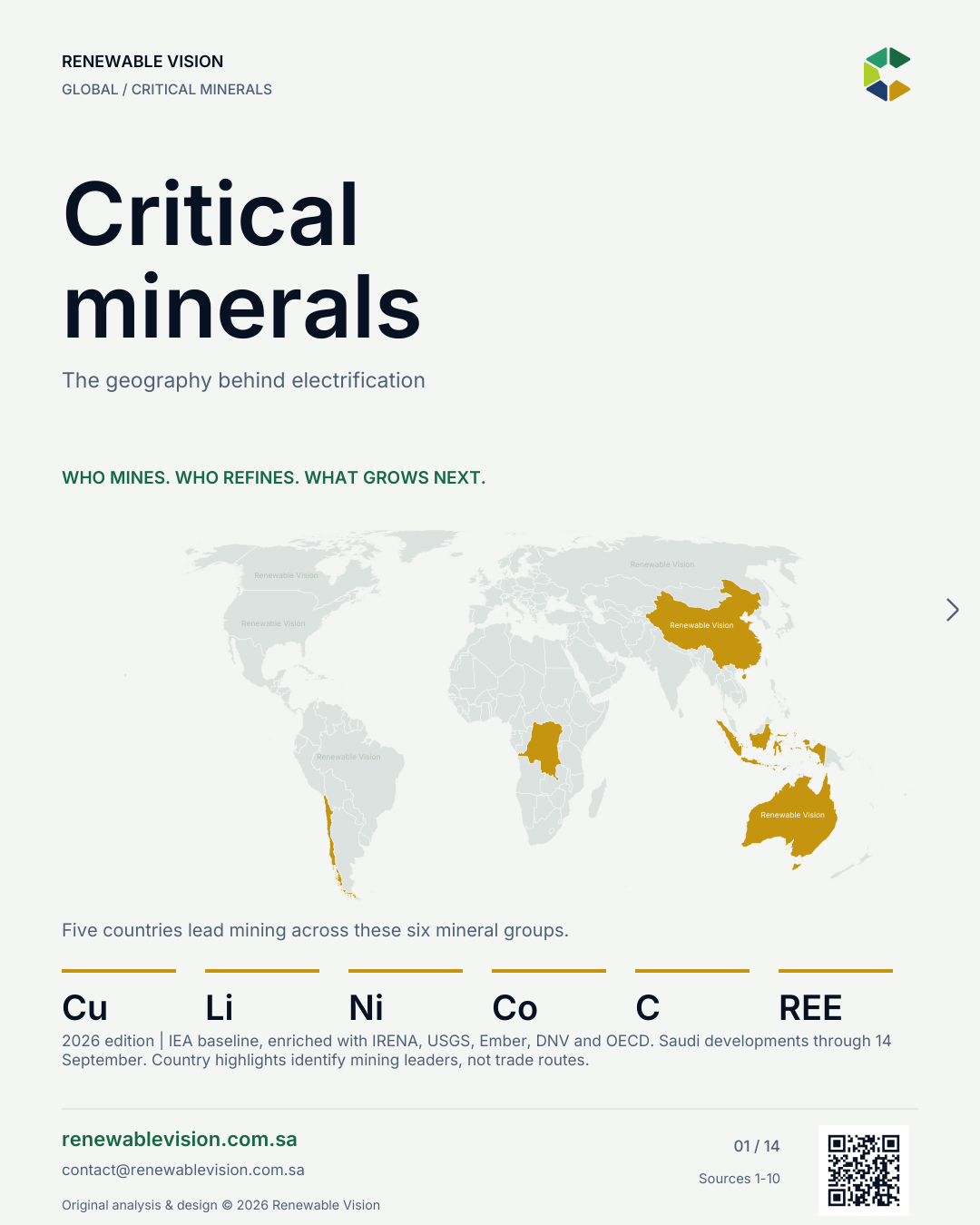
This Renewable Vision guide maps six mineral groups and examines the supply chains behind grids, batteries and clean-energy technologies. It combines the IEA baseline with IRENA, USGS, Ember, DNV, OECD and recent Saudi primary releases.
Inside the carousel:
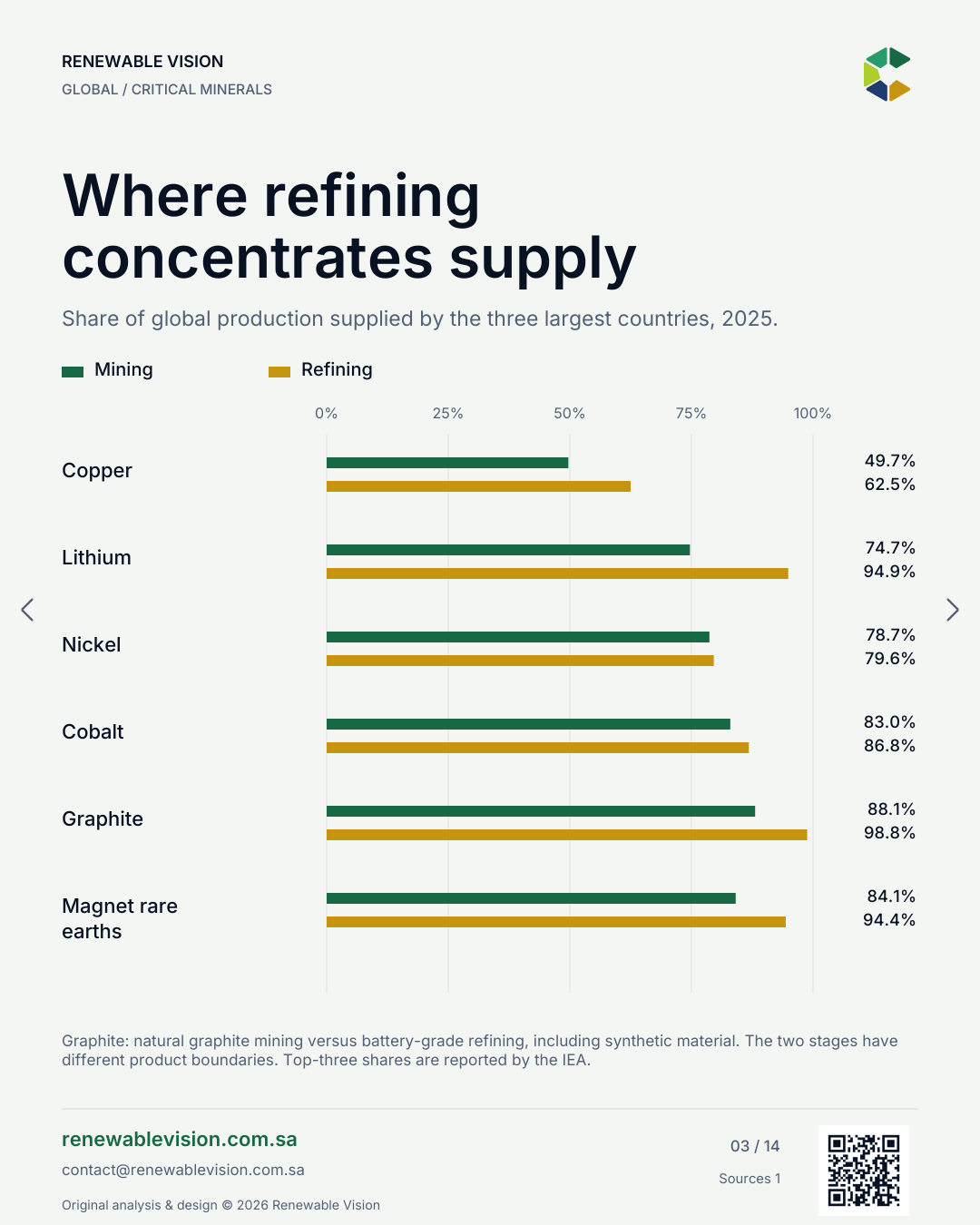
- Mining and refining concentration across copper, lithium, nickel, cobalt, graphite and magnet rare earths.
- Lithium reserves and a transparent comparison of IEA and USGS production estimates.
- Battery chemistry and recycling options that can change material demand.
- Saudi exploration and processing developments, including the September Jabal Sayid announcement.
The dates and definitions matter. A resource estimate is not operating supply. A forecast is not an observed result. Where sources differ, the comparison stays visible.
What the figures mean
Quoted from the report's own notes on scope and definitions, in the words it published them in.
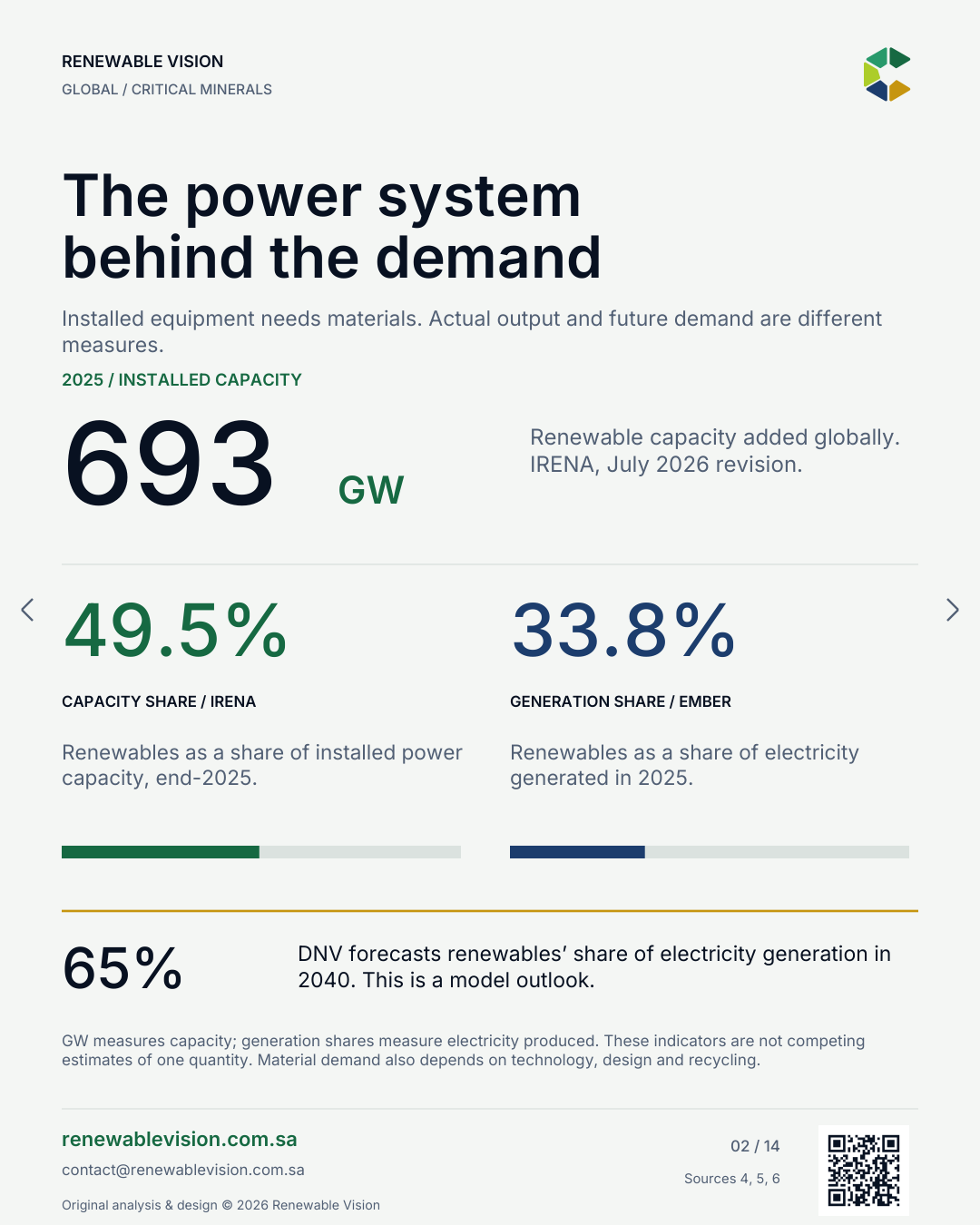
- IRENA July revised 2025 additions to 693 GW, from 692 GW in spring. Capacity and generation shares measure different things.
- SPA's original Arabic release gives about 114 million tonnes of ore at Jabal Sayid. Secondary 110 Mt reports were not adopted. This is a minister-announced estimated resource, not certified reserves or contained rare-earth/uranium mass. No project coordinates are invented.
- USGS lithium mine output excludes confidential US production; differences from the IEA total are not measured errors. Country-level cobalt estimates also differ and remain visible.
- USGS v1.3 table-based cobalt/graphite shares do not fully match its prose summaries. The reconciliation log preserves this mismatch.
- Resources, reserves, annual mining and refining output are distinct. USGS broad REE oxides cannot be directly compared with IEA magnet REEs (Pr, Nd, Tb, Dy).
- IEA graphite mining is natural graphite; battery-grade refining includes synthetic material; total demand covers all grades. Lithium is Li content, not LCE.
- Top-three shares are published IEA values. Country shares use matching stage totals. Demand growth is 2035 STEPS / 2025; projected supply is a separate probability-weighted base case.
- IEA and USGS can share upstream inputs. Energy Institute partners with Ember in 2026; OWID redistributions are not independent confirmations. OECD also draws on IEA and other studies.
Preview
3 of 14 pages shown
Get the report
Global critical minerals
The PDF and the data files are free for members. Membership takes a minute: verify an email address or a mobile number once, and the download opens along with the dashboards and CSV export.
Figures are as filed on 19 September 2026; live dashboards may differ.